
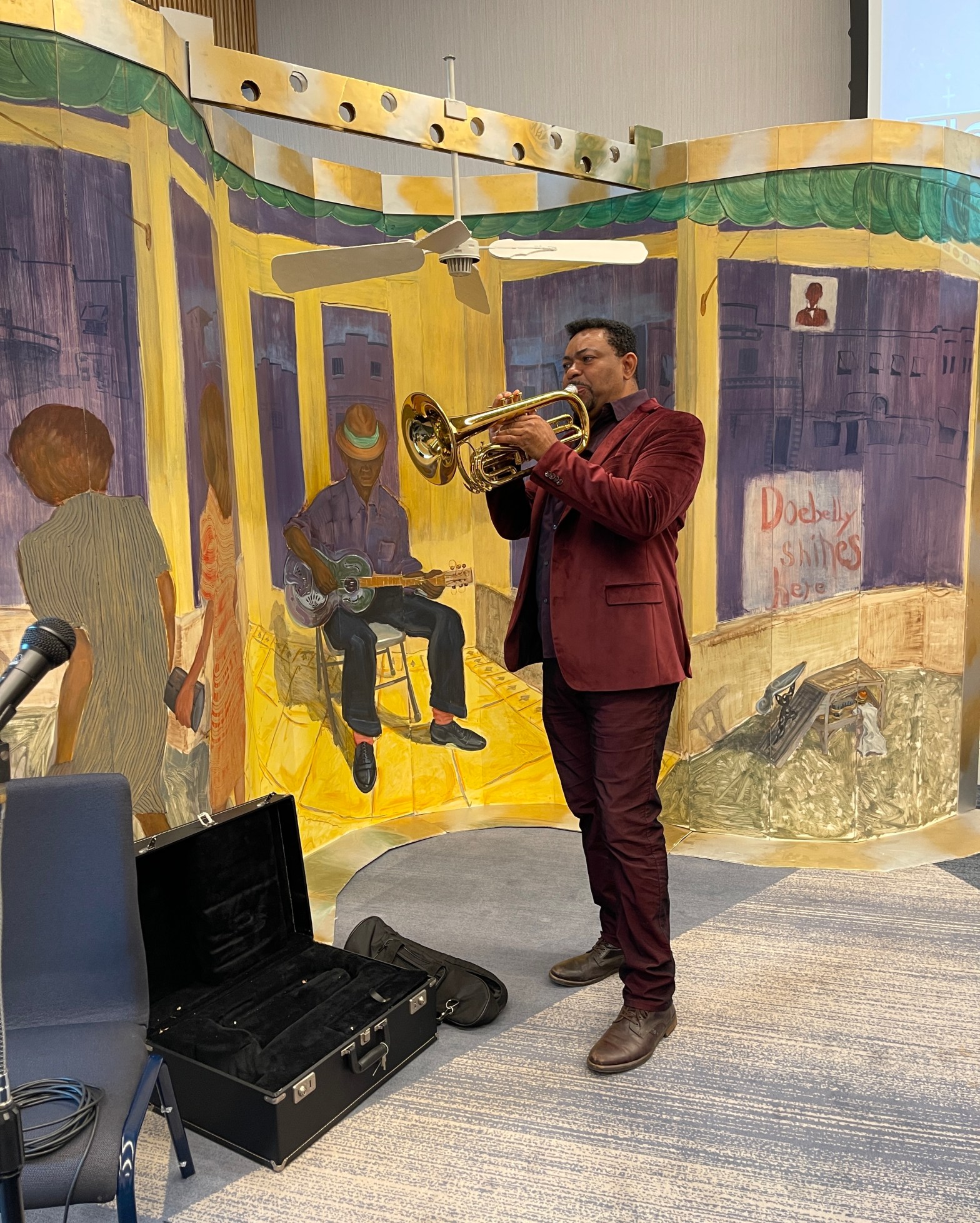
Remembering the Last Street Performer of Deep Deuce and the Vanishing Heart of Oklahoma City’s Jazz District.

A reflection from Milton R. Trice Part VI
Street Presence: Art, Survival, and the Unseen Narratives of the City
There are places that disappear physically but never truly vanish. They survive in memory, music, stories, and occasionally in the work of an artist who arrives just in time to preserve what remains.
For me, that place was Deep Deuce.
Long before urban renewal altered the landscape of Oklahoma City, Deep Deuce—known to many longtime residents simply as Deep Second—was one of the most important cultural districts in America. It was a neighborhood where music lived on the sidewalks, where entertainers performed for passing crowds, and where the sounds that would eventually shape jazz culture echoed through the streets.
It was here that I encountered a man known as Doe-belly.
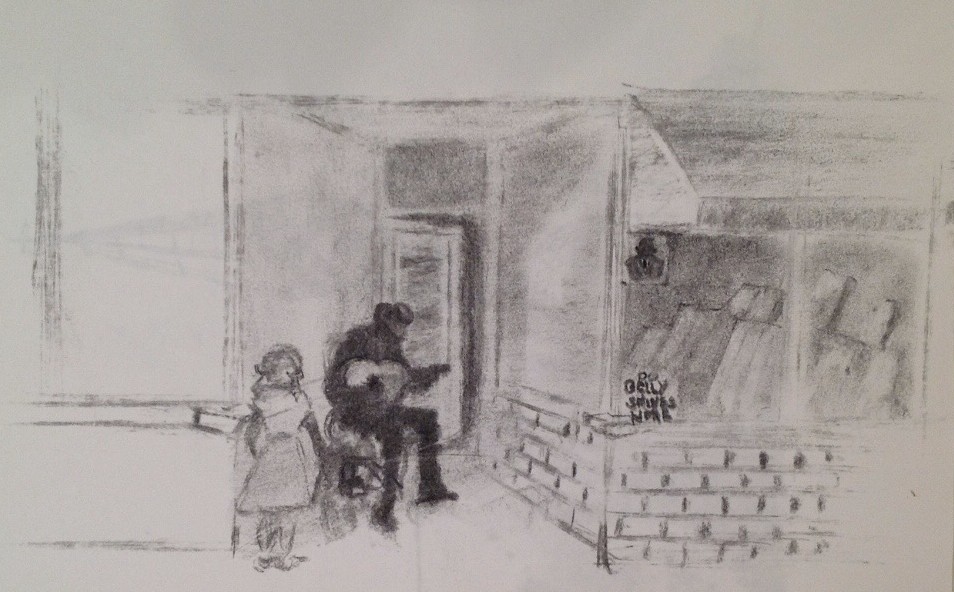
I first contacted him after reading an article about him in the newspaper. Years earlier, I had seen him standing outside his store playing guitar and had made a field sketch of him. The image stayed with me. I had always intended to turn that sketch into a painting, believing it represented a disappearing piece of American history.
When I finally called him, I explained who I was and why I wanted to visit.
I asked if he would like some doughnuts while I sketched.
“No,” he replied. “I need something more kickin’.”
What he wanted was Church’s Chicken with jalapeños.
When I arrived, Doe was already standing by the doorway waiting for me.
He was well into his eighties by then. Life had not been easy on him. Most people would have described his circumstances as poverty. Yet there was nothing poor about his spirit.
He accepted the food and carefully placed it on an old stove to keep warm. When I encouraged him to eat, he refused.
First, he wanted to talk.
First, he wanted to tell his story.
As I drew, Doe spoke about Deep Second Street.
He told me he had spent his entire life there.
“They finally made me leave,” he said.
During our conversation, people regularly knocked on his door bringing bottles and scrap materials. Doe acted as a small-scale wholesaler, purchasing items from others and reselling them to distributors. Even with government assistance, survival remained difficult.
Yet his memories remained rich.
He told me about the days when musicians, dancers, performers, and entertainers filled the streets. When major acts came to town, local performers would gather on the Deuce and entertain the crowds.
Then he smiled.
“My guitar playing wasn’t my real talent,” he said.
“Dancing was.”
As I continued sketching, I asked about an older photograph that showed him beside a portable shoeshine stand and his beloved collie dog.
The shoeshine equipment had been purchased years earlier by a university collector.

The dog, he said quietly, never returned after he was forced to move.
At one point another visitor arrived.
I answered the door because it had become difficult for Doe to stand.
I introduced myself.
The man replied simply:
“4:30.”
I introduced myself again.
“4:30.”
Only then did I realize that was his name.
The man turned out to be one of Doe’s oldest friends.
What he told me changed my understanding of the entire neighborhood.
According to him, Doe had arrived on Deep Second when he was only six or seven years old, before the street was even widely known by that name. He had largely grown up on his own.
Yet the community had raised him.
The street had taken care of him.
He also explained something I had never known.
White residents called the neighborhood “Deep Deuce.”
Black residents called it “Deep Second.”
When famous Black entertainers traveled through Oklahoma City during segregation, they often performed first on the white side of town where the larger money could be made. Afterwards they would come to Deep Second so their Black brothers and sisters could earn a living as well.
That was simply how life worked in those years.
A difficult system.
An unjust system.
But also a community that found ways to survive.
As our visit came to an end, Doe showed me a gift sitting on his porch.
It was an old six-seat shoeshine stand complete with beautiful iron footrests.
Someone had recently given it back to him.
When I looked at the stand and then back at Doe’s face, something became clear.
For years I had wondered what “Doe-belly Shines Here” truly meant.
It was never just about shining shoes.
It was about a man who had spent his life helping others shine.
A gifted performer.
A dancer.
A musician.
A survivor.
A storyteller.

A witness to an entire cultural world that was disappearing before our eyes.
As I drove away, I could still see Doe standing there watching me leave.
And I realized I wasn’t simply painting a man.

I was painting the last street performer of Deep Deuce.
The last living thread connecting Oklahoma City’s present to one of the great cultural districts of American music history.
Years later, I would come to understand something else.
Deep Deuce was Oklahoma City’s own Bourbon Street.
A place where music, stories, performance, and community shaped generations of lives.
This was where jazz first took root in Oklahoma before spreading outward into larger cultural movements. It was the home of legendary figures including Ralph Ellison, author of Invisible Man, and the celebrated jazz vocalist Jimmy Rushing, known to audiences worldwide as “Mr. Five by Five.”
By the time I painted Doebelly, much of the original Deep Deuce had already disappeared beneath urban renewal.
But Doe remained.
And through him, so did the memory.

The painting that emerged became the first life-sized Broken Plane painting I created using Stereo-Realism techniques.
More than an experiment in form, it became an act of preservation.
A portrait not only of a man, but of an entire neighborhood, a culture, and a musical legacy that helped shape America itself.
Sometimes the artist arrives just in time.

And sometimes a single painting becomes a witness.
Into the World of Milton R. Trice
With over four decades of artistic and street presence in Oklahoma City, Milton R. Trice explores the hidden narratives of the urban environment through personal encounters, observation, memory, and reflection. These stories reveal the human moments, philosophical questions, and social realities that continue to shape his artistic vision and the evolving language of Stereo-Realism.
Worldwide Art Advocacy
Supporting artists and creative voices around the world.
 Worldwide Art Advocacy