
From the Personal Reflections and Artistic Memory of Milton R. Trice
An intimate story of rediscovery, belonging, ceremony, and the spiritual connection between art and ancestral memory.
There are moments in life that arrive quietly, almost accidentally, yet remain spiritually alive within a person forever. For artist Milton R. Trice, one of those moments began during his freshman year of high school in Oklahoma with the discovery of an old family Bible.
Inside its aging pages, Milton encountered something that would forever alter the way he understood himself. Written within the genealogy were traces of his Native American ancestry connected to the Choctaw Nation. For the young artist, the discovery felt less like historical information and more like the opening of a hidden doorway into identity, memory, and belonging.
What fascinated him most were the names and stories attached to that lineage: warriors, peace chiefs, scouts, and women whose lives seemed to echo from another America entirely. The discovery awakened something deeply personal within him. It gave shape to an ancestry he had never fully understood, yet somehow had always felt.
As a boy growing up in Oklahoma, Milton had already formed close friendships with Native American families. One of his closest childhood friends was a full-blood Cherokee boy named Tommy Bell. Their friendship introduced Milton to a world that felt ancient, proud, and spiritually grounded.
He still remembers visiting Tommy’s family home near the railroad tracks — a massive Victorian house filled more with simplicity than wealth. The structure itself seemed enormous to a child, yet the family lived modestly within it. Milton recalls the quiet strength of Tommy’s father, a powerful railroad foreman whose physical presence left a permanent impression on him.
That day, Tommy formally introduced Milton to his father for approval, a gesture of deep cultural respect. Without many words, the elder simply nodded and grunted his acceptance. For Milton, it became a moment of belonging he would never forget.
Years later, fate would unexpectedly reconnect him to that ancestry through the very thing that had shaped his life most profoundly: art.
During the 1980s, Milton served as the Cathedral Artist for the Episcopal Church in Oklahoma at Saint Paul’s Cathedral, where the bishop resided. During this period, he created one of the most important drawings of his career — a portrait of David Pendleton Oakerhater, also known as “Making Medicine” or “Sun Dancer,” the Cheyenne man who became the first Native American saint recognized within the Episcopal Church. Rendered in ink and watercolor, the portrait became one of Milton’s most celebrated works for the church and appeared on the cover of the Episcopalian newsletter. The image carried more than artistic importance; it became a spiritual bridge between sacred Christianity and Native American memory.

The recognition of Oakerhater’s sainthood led to a powwow celebration at Roman Nose State Park in Oklahoma — an event Milton attended with his wife. What he experienced there would remain with him for the rest of his life.
The dance began at sundown beneath a full moon, with a massive bonfire burning at the center of the gathering while great kettle drums thundered from the side. As Milton and his wife joined the tribe in dance, the rhythm of the drums and chanting gradually became hypnotic. Everything seemed to move and stand still at the same time.
In that moment, Milton began to understand how the great Native warriors spiritually prepared themselves before battle — entering a state of courage, protection, and fearlessness through ceremony, rhythm, and movement.
To Milton, the dance itself seemed to place a spiritual film of protection around the warriors against arrows, bullets, and fear. It was this spiritual warfare of the mind and spirit, he realized, that gave many of the braves the courage to Count Coo, ride directly before enemy lines, or dare their enemies to shoot while demonstrating fearlessness and honor before battle.
He later reflected on how some of the great warriors would ride on horseback directly toward enemy cavalry lines, challenging death itself through acts of extraordinary courage. Others practiced what was known as “Counting Coo” — approaching an enemy close enough to touch them without killing them, then disappearing back into battle, proving bravery through restraint rather than destruction.
Within the powwow ceremony, Milton sensed echoes of that same spiritual preparation, ancestral memory, and warrior consciousness still surviving through dance, rhythm, and ritual.
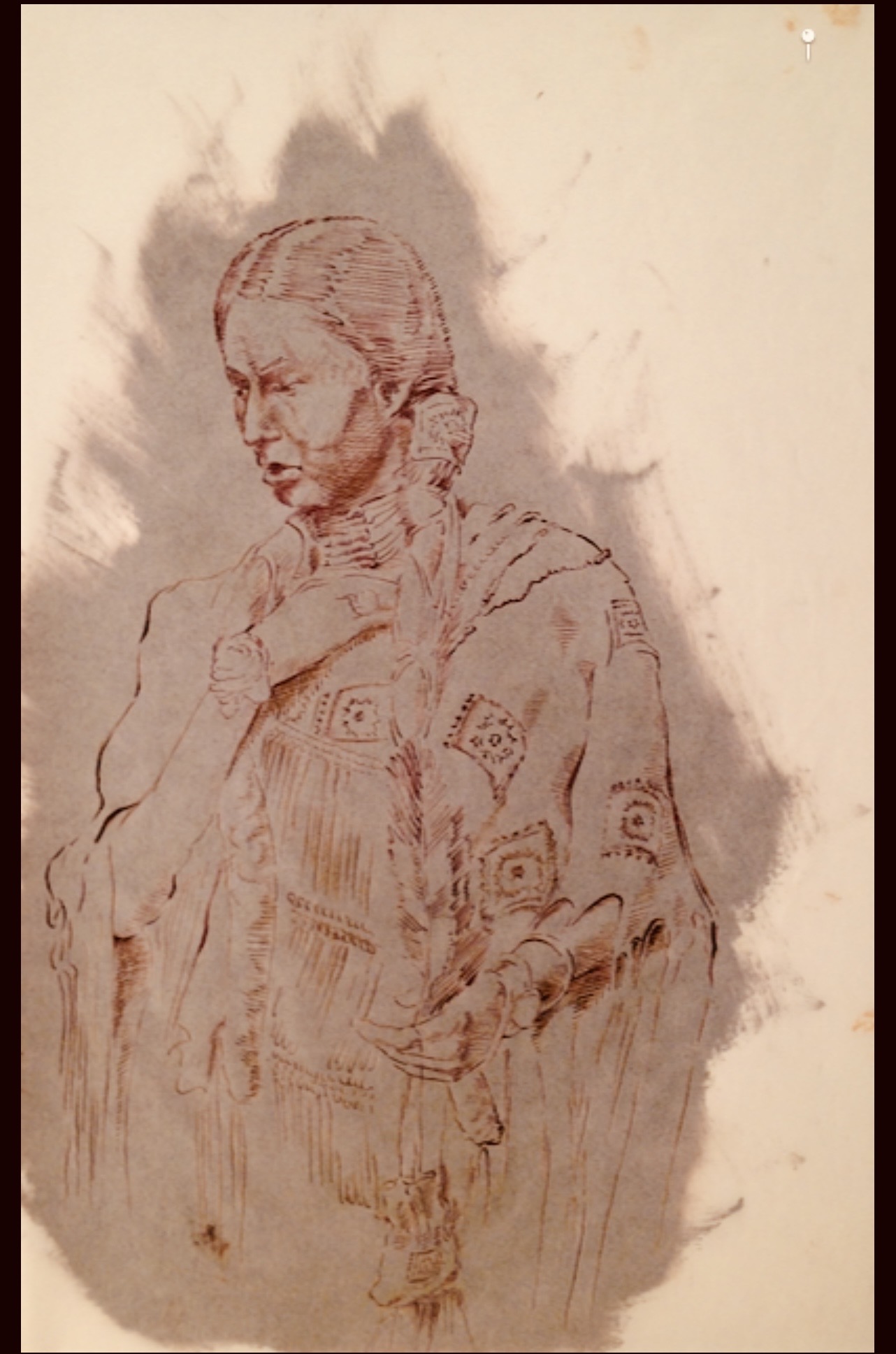
At one point during the celebration, Milton met Oakerhater’s great-granddaughter, who served as the lead women’s dancer. Dressed in beautifully embroidered traditional clothing, she embodied the living continuation of ancestral memory itself. Milton instinctively sketched and photographed her, preserving the moment through the eyes of an artist.

During the celebration, Milton outbid the crowd for the Head Chanter’s Dancing Shaw, purchasing it as a gift for his wife — a gesture that became part of the spirit and emotional memory of the evening itself.
As the night faded and the fire slowly diminished into embers, Milton realized something inside himself had quietly become whole.
Through art, ceremony, memory, and spiritual experience, he had revisited a forgotten part of his ancestry — not through history books alone, but through living human connection.
Today, a copy of Milton R. Trice’s celebrated drawing of David Pendleton Oakerhater hangs at Saint Crispin Episcopal Retreat in eastern Oklahoma, preserving both artistic achievement and cultural remembrance within sacred space.

For Milton, art has never simply been about creating images. It has always been about recovering vision — spiritual vision, historical vision, and human vision. In Art and Ancestry, that vision becomes something larger than personal memory. It becomes a meditation on identity, belonging, ceremony, and the mysterious ways ancestry sometimes returns to us through the work we are called to create.
For over four decades, Milton R. Trice has continued to pursue a deeply personal artistic path shaped by spirituality, memory, perception, ancestry, and the hidden narratives of the city. From sacred church commissions and philosophical reflections to the development of Stereo-Realism, his work stands as both artistic exploration and visual testimony.
Explore more stories, paintings, spiritual reflections, and the evolving philosophy of Milton R. Trice through Worldwide Art Advocacy.
— Published by Worldwide Art Advocacy
supporting artists and creative voices around the world.
 Worldwide Art Advocacy