

Historical Background: A Flourishing Kingdom
The Benin Kingdom (not to be confused with the modern country Benin) had long been a centre of political centrality and artistic excellence. Ruled by the Oba, Benin produced spectacular bronzes, ivory carvings and regal paraphernalia that recorded history, lineage and spiritual life. European contact — beginning with the Portuguese in the 15th century — brought trade, but the kingdom retained its sovereignty and cultural order well into the 19th century.
Immediate Causes: Trade, Power, and the Phillips Mission
By the late 1800s, British interests in palm oil and other commodities grew intense. The Oba’s regulation of trade — insisting on a royal monopoly and formal engagement — frustrated British merchants and officials who sought unfettered access. Tensions peaked when Acting Consul-General James R. Phillips led a delegation to Benin City in January 1897 despite warnings that the Oba could not receive visitors for religious reasons. The mission was ambushed near Ughoton, resulting in the deaths of Phillips and most of his party. The British government used the incident to justify a punitive military response.
The Expedition: From March to the Fall of Benin
In February 1897, a combined force under Rear-Admiral Sir Harry Rawson — roughly 1,200 troops strong and equipped with modern weaponry — advanced on Benin City. Resistance by Benin warriors was courageous but overwhelmed by superior firepower. Benin City was sacked, palaces and shrines were burned, and the Oba — Ovonramwen Nogbaisi — fled and was later captured and exiled to Calabar.
“The destruction was not only physical but spiritual — an assault on memory, tradition and identity.”
Looting and the Benin Bronzes
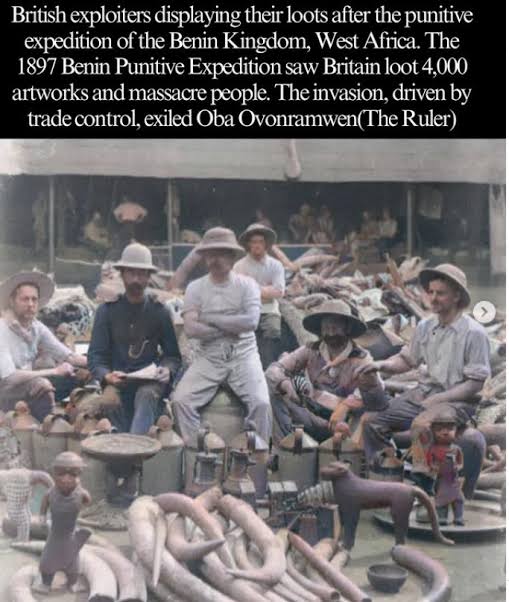
Perhaps the most lasting consequence was the wholesale looting of Benin’s royal art. Thousands of bronzes, ivory tusks, coral regalia and wooden carvings were seized and shipped to Europe. Auctioned to defray the cost of the expedition, these masterpieces entered museums and private collections across Britain, Germany, Austria and the United States. Today they are revered for their aesthetic and historical value — even as their removal is a glaring example of colonial plunder.
Political and Social Aftermath
The British dismantled Benin’s political institutions and inserted colonial administrators, effectively ending indigenous sovereignty. Local economies and social networks were disrupted, while sacred spaces and rituals suffered irreversible damage. The exile of Oba Ovonramwen symbolised the fall of a centuries-old political order.
Legacy: Restitution, Memory, and Revival
The story of Benin is at the heart of contemporary debates about cultural restitution and historical justice. Repatriation campaigns led by Nigerian authorities and cultural institutions have gained momentum. Several museums and governments in Europe have begun processes of return or negotiation, acknowledging that many objects were taken unjustly.
But restitution is only part of the conversation. Restoring heritage also means supporting museum infrastructures, curatorial training, and cultural centres in Nigeria — work that helps contextualise returned pieces and reconnects them with living traditions.
Conclusion
The Benin Punitive Expedition of 1897 was more than a military campaign: it was an act that attempted to unmake a civilisation. Yet Benin’s artistic legacy survived, carried in the memory and artistry of its people. As museums and nations grapple with restitution, the Benin story reminds us that art is not merely object — it is identity, history, and moral claim.
Call to action: If you care about cultural justice and the future of African heritage, support repatriation efforts and institutions like Nigeria’s National Commission for Museums and Monuments and the Edo Museum of West African Art.
 Worldwide Art Advocacy