
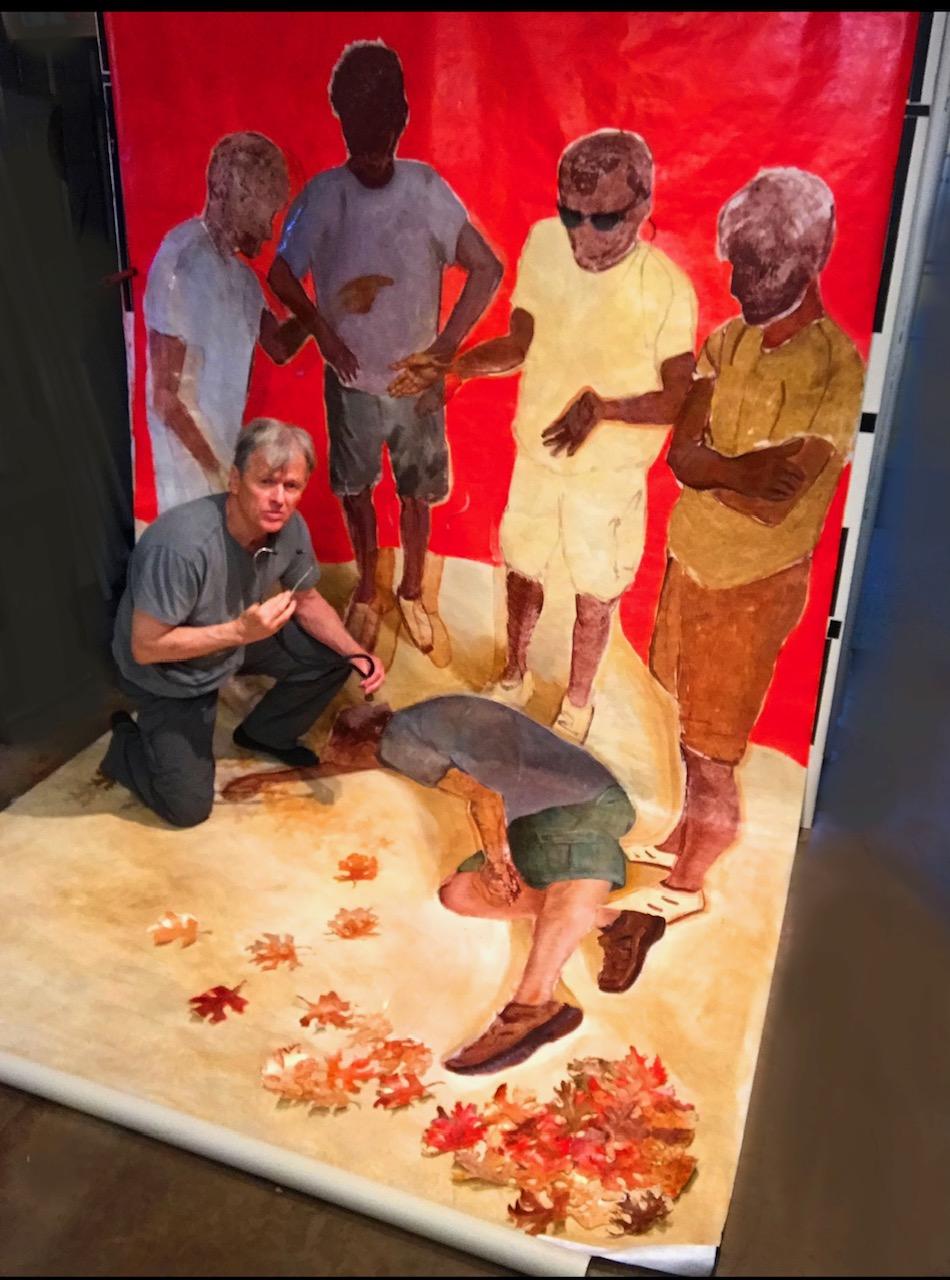
A reflection from Milton R. Trice Part III
By Worldwide Art Advocacy
There are moments that stay with you—not because they were resolved, but because they refused to be. Steven was one of those moments.
Am I my brother’s keeper?
For years, I found myself returning to a single question—not about the man in the doorway, but about the moment he refused me.
Why would someone with so little turn away money…and even more, turn away being seen?
At first, I thought I was offering help. Later, I wondered if I was offering something else entirely—a narrative, a framing, a way of turning his reality into my statement.
Perhaps Steven wasn’t in that doorway by accident.
Perhaps it was the last place that still belonged entirely to him.
For two years, I observed him sleeping in a doorway in downtown Oklahoma City, at the corner of NE Reno and Classen Blvd. Always in the same place, positioned with a southern exposure to catch the warmth of the sun. It was not just where he stayed—it was where he existed, consistently, without movement or explanation.
One Thanksgiving night, I stopped late and gave him $30 for dinner. He barely acknowledged me or the gesture.
A year later, I found myself in the area again. I decided to stop—this time with more intention. As I approached him, I asked if he would mind if I made a drawing or painting of him. At the same time, I slipped a $50 bill into his hand.
He looked straight at me and said: “This would not be right for you to do such a thing, because this is a federal area.”
Surprised, I pushed back. “Yes I can. It’s not against the law—you know.”
“Yes it is,” he responded. “This is a federal protected area, and you could be arrested.”
Taken aback, I tried to reason with him. “Look, it’s not like I’m down here pushing drugs. I’m an artist—I’d be painting a picture of you. It wouldn’t get you in trouble.”
“Yes it is—and yes you will,” he said.
Distressed, I replied, “This is a democratic society. I have a constitutional right to be here on this sidewalk painting a picture.”
He answered, calmly but firmly: “No, it’s not. Not all the people vote… nor do they know what’s really going on.”
That response caught me.
At the time, it felt like resistance. Years later, it revealed something deeper.
He wasn’t speaking about democracy in theory—he was speaking about exclusion in reality. About those who exist outside the systems that claim to represent them. People like himself—visible, yet unheard; present, yet uncounted.
With the exchange going nowhere, I said, “Okay, I won’t draw your portrait. Just keep the money as a gift.”
“No,” he replied. “I don’t need this.”
Shocked, I tried once more. “Look, I’m a social painter. I’m just trying to make a visual statement about our society.”
He answered without hesitation: “It’s not my statement—it’s yours. I’m making my own social statement myself, without you.”
That was the end of it.
I said, “Well, okay… may God bless you,” and walked away—with the $50 still in my hand.
I got back into my truck and drove off—perplexed, but also aware that something had just shifted.
For a long time, I tried to make sense of it. I questioned the logic of his arguments, the contradictions, even the legal claims he made. But over time, those details became less important than what was actually being protected.
That doorway was more than a place to sleep.
It was the last place that belonged entirely to him.
A boundary he defined.
A space he controlled in a world where control is often stripped away.
And he was not willing to risk that—for money, for representation, or for my interpretation of his life.
In refusing, he preserved something essential.
Not just privacy—but authorship.
Years later, I kept my promise. I never painted Steven.
Instead, I painted five versions of myself—arguing over his situation. Across the canvas, one question emerged:
“Am I my brother’s keeper?”
As an artist, that moment forced a realization:
Not everything is meant to be captured.
Not every life is available to interpretation.
Some truths exist only in the act of being lived—unseen, unframed, and fully owned by the one who lives them.
Steven never entered my work as an image.
But in many ways, he shaped it more than those who did.
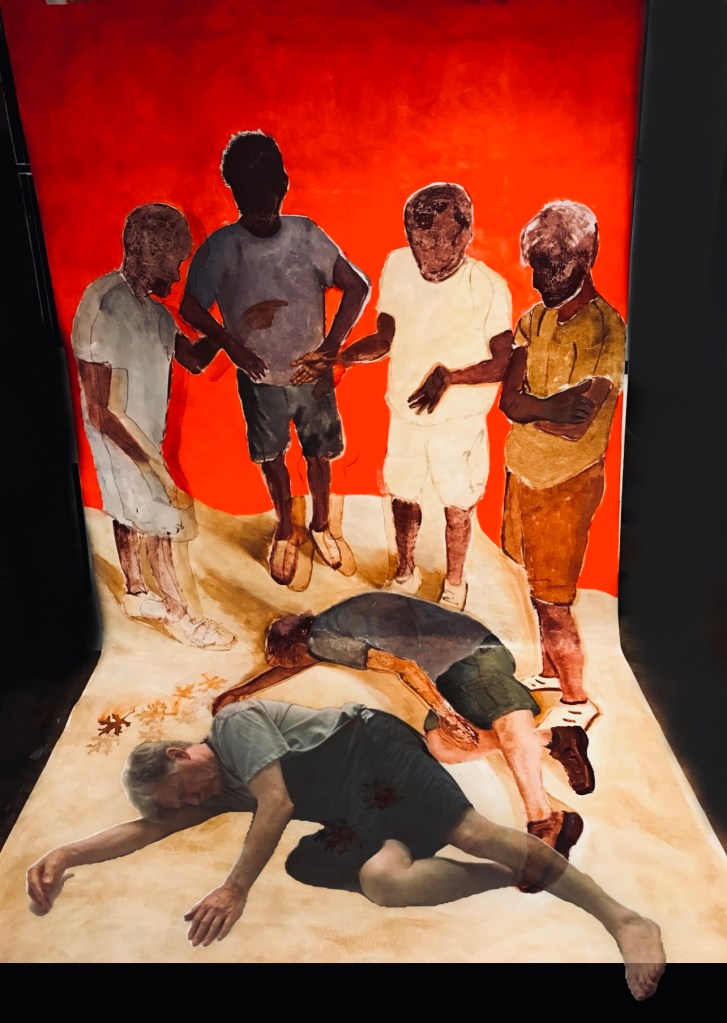
Steven in the Doorway — The Last Place That Belonged to Him
For over four decades, I have painted the homeless on the streets of Oklahoma City—not as subjects I set out to find, but as a presence that continually revealed itself within the environments I was drawn to paint. They were already there, embedded in the city’s rhythm, quietly shaping its truth.

My work is not about spectacle. It is about presence.
About witnessing what is often overlooked, yet deeply embedded in the fabric of our society.
Because sometimes, the most powerful stories are not staged—
they simply appear, and remain.
Explore more works and writings by Milton R. Trice through Worldwide Art Advocacy and discover the evolving philosophy behind Stereo-Realism.
Worldwide Art Advocacy
supporting artists and creative voices around the world.
 Worldwide Art Advocacy